sklvq.discriminants.RelativeDistance
- class sklvq.discriminants.RelativeDistance[source]
Relative distance function
Class that holds the relative distance function and gradient as described in [1].
References
[1] Sato, A., and Yamada, K. (1996) “Generalized Learning Vector Quantization.” Advances in Neural Network Information Processing Systems, 423-429, 1996.
- __call__(dist_same: ndarray, dist_diff: ndarray) ndarray[source]
- The relative distance discriminant function for a single sample (
 ):
): 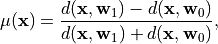
with
 the prototype with the same label and
  the
prototype with a different label.
the
prototype with a different label.- Parameters:
- dist_samendarray with shape (n_samples, 1), with n_samples >= 1
Shortest distance of n_samples to a prototype with the same label.
- dist_diffndarray with shape (n_samples, 1), with n_samples >= 1
Shortest distance of n_samples to a prototype with a different label.
- Returns:
- ndarray with shape (n_samples, 1)
Evaluation of the relative distance discriminative function.
- The relative distance discriminant function for a single sample (
- gradient(dist_same: ndarray, dist_diff: ndarray, same_label: bool) ndarray[source]
Computes the relative distance discriminant function’s gradient.
The partial derivative with respect to the closest prototypes with the same label (same_label=True):

The partial derivative with respect to the closest prototypes with a different label (same_label=False):

with
 the distance to the prototype with the same label
and
the distance to the prototype with the same label
and  the distance to the closest prototype with a
different label.
the distance to the closest prototype with a
different label.- Parameters:
- dist_samendarray with shape (n_samples, 1), with n_samples >= 1
Shortest distance of n_samples to a prototype with the same label.
- dist_diffndarray with shape (n_samples, 1), with n_samples >= 1
Shortest distance of n_samples to a prototype with a different label.
- same_labelbool
Indicating if the derivative with respect to a prototype with the same label (True) or a different label (False) needs to be calculated.
- Returns:
- ndarray with shape (n_samples, 1)
Evaluation of the relative distance function’s gradient.